

The tech-heavy Nasdaq declined on Thursday as investors renewed concerns about the sustainability of artificial intelligence (AI) spending, despite Nvidia posting stronger-than-expected quarterly results.
Nvidia reported that its quarterly profits more than doubled to $43 billion and projected continued growth in the coming months. However, the positive earnings failed to lift investor sentiment. Shares of the chipmaker fell 5.5 percent by the close of trading, signaling a shift in market confidence around AI-driven stocks.
Market analysts said the reaction highlighted growing unease about the broader AI investment cycle. Dan Coatsworth, head of markets at AJ Bell, noted that a company surpassing revenue expectations by billions of dollars would typically see a positive share price response. Instead, the stock declined, reflecting what he described as changing market sentiment.
Concerns center around whether the heavy capital spending by large technology companies on AI infrastructure will translate into sustainable profits. Jack Ablin of Cresset Capital Management said that while Nvidia’s standalone results were strong, hyperscale technology firms are currently spending significantly more than they are generating in revenue.
Investors fear that any slowdown in AI-related investment could ripple across the entire technology supply chain, directly affecting companies like Nvidia that benefit from high levels of capital expenditure.
The Nasdaq Composite closed down 1.2 percent at 22,878.38, ending a two-day rally. The S&P 500 declined 0.5 percent to 6,908.86, while the Dow Jones Industrial Average edged up less than 0.1 percent to close at 49,499.20.
European markets, in contrast, posted gains. London’s FTSE 100 rose 0.4 percent to a record 10,846.70, supported by a 4.5 percent surge in Rolls-Royce shares after the company upgraded its guidance, announced a share buyback, and reported strong annual profits. Paris’ CAC 40 climbed 0.7 percent to cross the 8,600 mark for the first time, while Frankfurt’s DAX gained 0.4 percent.
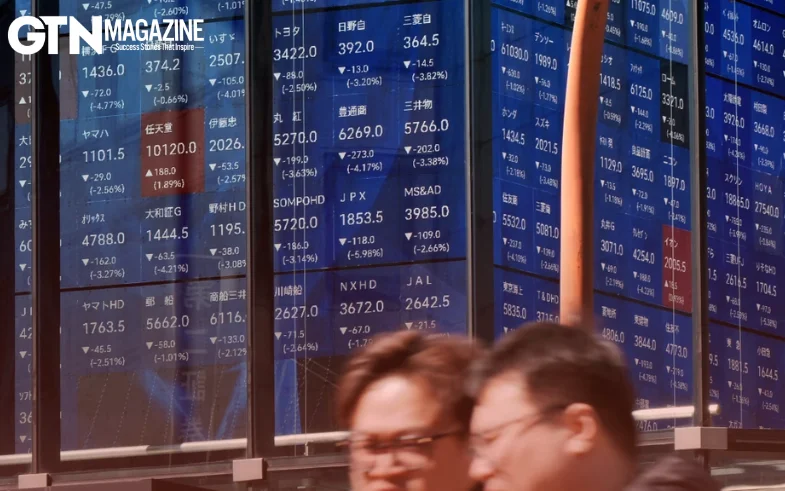
In Asia, performance was mixed. Tokyo’s Nikkei 225 rose 0.3 percent to a record 58,753.39. South Korea’s Kospi index advanced more than three percent to a fresh high, driven by gains in Samsung and SK hynix, bringing its year-to-date increase close to 50 percent. Meanwhile, Hong Kong’s Hang Seng Index fell 1.4 percent, and Shanghai’s Composite index remained flat.
Currency markets also reflected shifting investor sentiment. The Japanese yen strengthened slightly against the US dollar, trading at 156.11 per dollar. The move followed reports that Japan’s prime minister had nominated two policy-dovish academics to the Bank of Japan board, raising expectations of a cautious approach toward further interest rate hikes.
In corporate developments, shares of Stellantis rose six percent in New York trading. Although the automaker reported a net loss of 22.3 billion euros for the previous year, much of the loss was attributed to asset write-downs as the company adjusts its strategy away from electric vehicles.
Oil prices were marginally lower. West Texas Intermediate crude fell 0.3 percent to $65.21 per barrel, while Brent crude slipped 0.1 percent to $70.75 per barrel.
The latest market moves suggest that while corporate earnings remain robust in parts of the technology sector, investors are increasingly scrutinizing the long-term profitability of massive AI investments. The reaction to Nvidia’s results may signal a broader reassessment of growth expectations within the tech industry.