

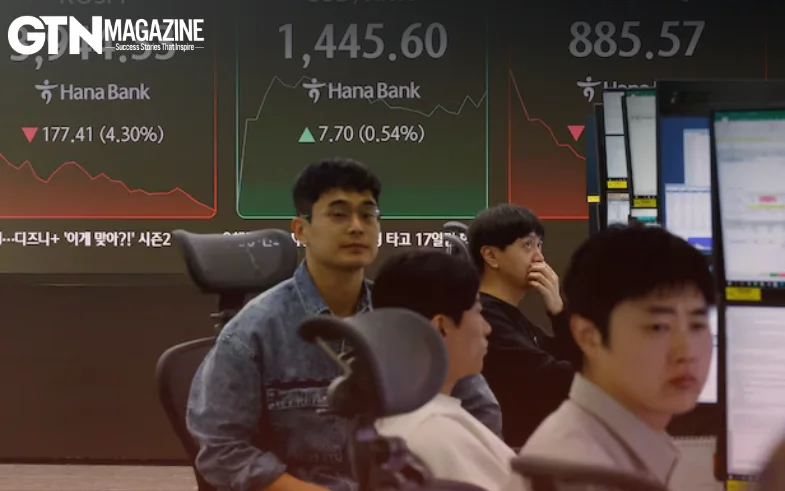
Seoul: South Korean stock markets fell sharply on Monday, leading losses across Asia-Pacific markets, as heavy selling triggered a temporary trading halt in index futures.
The benchmark KOSPI dropped more than 4 per cent, while Kospi 200 futures slid as much as 5 per cent, activating the market’s sidecar mechanism, which briefly halts program trading to curb volatility.
Market heavyweights were among the worst performers. SK Hynix fell 6.66 per cent, while Samsung Electronics dropped 5.55 per cent. The small-cap Kosdaq index also declined sharply, losing 4.45 per cent.
Regional markets under pressure
Broader Asia-Pacific markets traded lower as investors assessed fresh data on China’s factory activity and continued to react to sharp declines in precious metals.
A private survey showed China’s manufacturing activity expanded modestly in January. The S&P Global-compiled RatingDog China General Manufacturing PMI rose to 50.3 from 50.1 in December, marking the strongest reading since October. A level above 50 indicates expansion.
Despite the data, regional sentiment remained cautious.
Japan’s Nikkei 225 edged up 0.13 per cent, while the Topix gained 0.52 per cent. In contrast, Hong Kong’s Hang Seng Index fell 1.64 per cent, and mainland China’s CSI 300 slipped 0.68 per cent. Australia’s S&P/ASX 200 declined about 1 per cent.
Gold, silver and crypto in focus
Investor attention also remained on precious metals following last Friday’s steep sell-off. Spot gold traded about 5 per cent lower at $4,612 per ounce, while silver slid around 4 per cent to $81.18.
Silver prices, which had more than doubled over the past year, plunged nearly 30 per cent last Friday, marking their worst single-day fall since 1980. Gold also fell roughly 9 per cent.
In digital assets, Bitcoin dropped below $80,000 for the first time since April, trading around $76,700, signalling further risk aversion among investors.
US markets and outlook
US stock futures moved lower in early Asian hours. Dow futures slipped 0.3 per cent, S&P 500 futures fell 0.6 per cent, and Nasdaq-100 futures declined nearly 1 per cent.
Wall Street ended last week lower as technology stocks underperformed, although the S&P 500 still posted a gain for January despite heightened volatility.
Markets are expected to remain sensitive in the near term as investors monitor global growth signals, commodity price swings, and policy developments from major economies.