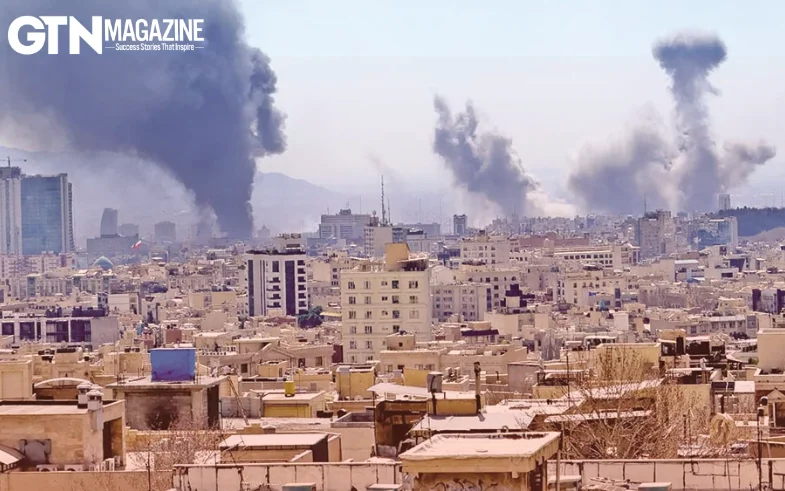
The Middle East has entered a new phase of conflict after the United States and Israel launched major strikes on Iranian targets over the weekend, raising fears of wider instability and global market disruption.
Iran’s state media confirmed that Supreme Leader Ayatollah Ali Khamenei was killed in the attacks. U.S. President Donald Trump described the operation as a decisive move aimed at ending long-standing security threats and preventing Iran from developing nuclear weapons. He said military operations would continue until U.S. objectives are achieved but also indicated that talks with Iran remain possible.
Iran Retaliates
Iran responded with a large wave of missile and drone strikes across the region. Several countries hosting U.S. military bases were targeted, along with Israel.
Air raid sirens sounded across Israel as missiles were launched, many of which were intercepted by air defence systems. Explosions were also reported in parts of the United Arab Emirates, Qatar, Jordan, Bahrain and Saudi Arabia.
Drone strikes caused damage and injuries at Dubai International Airport and Zayed International Airport in Abu Dhabi. Airspace closures followed across much of the region.
Iran’s foreign ministry said the country “will not hesitate” to respond to further attacks. President Trump warned that additional retaliation would be met with stronger action.
Markets Prepare for Volatility
Investors are preparing for significant market swings when trading resumes. Analysts expect “risk-off” moves, with demand rising for safe-haven assets such as gold and the U.S. dollar, while stock markets may face pressure.
Oil prices have already reacted sharply. Traders are closely watching the Strait of Hormuz, a key global oil transit route. More than 14 million barrels per day passed through the Strait in 2025, representing about one-third of global seaborne oil exports.
If the Strait becomes unsafe for shipping, analysts warn oil prices could surge above $100 per barrel.
Cryptocurrency markets also showed volatility, with Bitcoin initially falling before recovering some losses.
Travel Disruptions Spread
The conflict has caused major travel disruptions. More than 1,800 flights were canceled across the Middle East on Saturday, with another 1,400 cancellations reported on Sunday.
Several airlines suspended operations, including Qatar Airways. Services at Dubai International Airport were also halted temporarily.
Airspace closures forced airlines worldwide to reroute or cancel flights, affecting travel as far away as Europe, Australia and South America.
What Comes Next
Markets and governments are closely watching how the conflict develops. Analysts say the key risks include potential oil supply disruptions, prolonged regional fighting and broader economic consequences.
Energy prices and currency movements are expected to provide early signals of how severely investors are pricing in the crisis.