


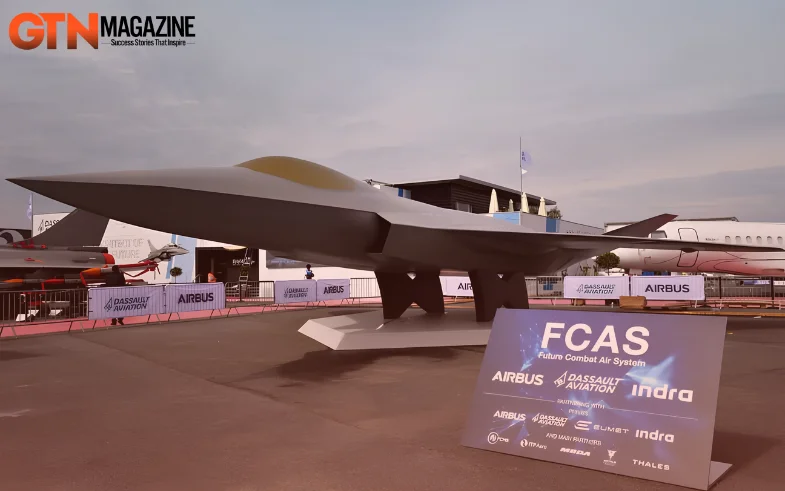
A consortium led by Airbus has proposed a new next-generation fighter jet programme to the German government following the collapse of the Franco-German Future Combat Air System (FCAS), one of Europe's most ambitious defence projects.
The proposal was submitted to German Defence Minister Boris Pistorius by a coalition of major German defence and aerospace companies, including Airbus Defence and Space, Hensoldt, Autoflug, Diehl Defence, Rohde & Schwarz, Liebherr, MBDA, and MTU Aero Engines.
The development comes just one day after German Chancellor Friedrich Merz and French President Emmanuel Macron formally ended the FCAS programme, bringing an end to years of industrial and political disagreements that had stalled progress on the project.
Hensoldt confirmed its participation in the initiative, stating that the companies had jointly prepared a strategic position paper outlining an alternative vision for the Future Combat Air System and its associated Next Generation Weapon System (NGWS).
According to reports, the proposal has been delivered to both the German Defence Ministry and the Chancellor's Office for consideration.
German Defence Minister Boris Pistorius acknowledged the existence of the proposal and said government officials are currently evaluating future options for Germany's next-generation air combat capabilities.
"We are assessing which direction we take," Pistorius said, adding that discussions with industry stakeholders had been ongoing for several months.
The minister expressed disappointment over the failure of the original FCAS programme, which had long been regarded as a cornerstone of European defence cooperation.
"It pains me," Pistorius said. "I understand the importance of Franco-German cooperation in Europe, but at some point decisions must be guided by practical realities."
The FCAS project was launched to develop a sixth-generation combat aircraft and an integrated system of advanced military technologies designed to strengthen European defence capabilities. The initiative gained additional strategic importance amid growing security concerns related to Russia and shifting transatlantic defence dynamics.
However, the programme faced repeated delays as disagreements emerged between France's Dassault Aviation and Airbus over industrial leadership, intellectual property rights, and development responsibilities.
German industry partners opposed proposals that would have granted Dassault a larger role in overseeing aircraft development, creating tensions that ultimately proved difficult to resolve.
Differences in military requirements also contributed to the project's collapse. Germany and France reportedly diverged on key operational priorities, including nuclear mission capabilities and aircraft carrier compatibility.
Chancellor Merz has previously argued that Germany's defence needs differ significantly from those of France, particularly regarding aircraft designed to carry nuclear weapons or operate from naval carriers.
Industry observers view the Airbus-led proposal as an effort to preserve Germany's ambitions for an advanced European combat aircraft while maintaining the technological expertise and industrial capacity developed under the FCAS framework.
Further details regarding the alternative fighter jet programme are expected to be unveiled during the Berlin International Aerospace Exhibition (ILA) later this week.
The outcome of the proposal could play a significant role in shaping the future of European defence aviation and determining how Germany pursues next-generation air combat capabilities following the end of one of the continent's most prominent defence collaborations.
More News:-