
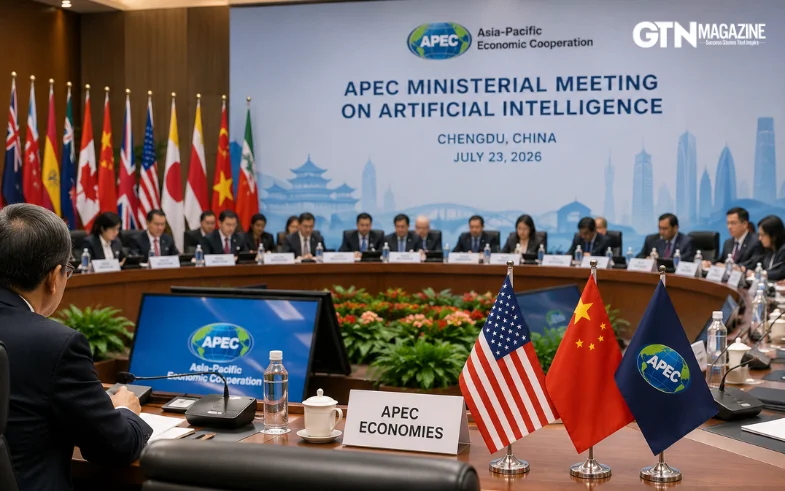
The United States, China, and 19 other Asia-Pacific economies have jointly endorsed the development of open-source artificial intelligence with strong security safeguards, marking a significant step toward international cooperation on AI governance despite growing geopolitical competition.
The agreement was outlined in the "Chengdu Statement on Artificial Intelligence," released during the APEC Digital Weeks ministerial meetings in Chengdu. The declaration calls for the responsible development and deployment of open-source AI while emphasizing cybersecurity, data protection, intellectual property rights, and secure digital infrastructure.
The statement encourages support for open-source AI models and projects that incorporate "strong security assurance" throughout their development and deployment. The language reflects increasing efforts by governments to balance AI innovation with safeguards against misuse as advanced AI technologies become more widely accessible.
China's Minister of Industry and Information Technology, Li Lecheng, who chaired the ministerial meeting, described the declaration as the first APEC minister-level statement to explicitly support cooperation on open-source artificial intelligence.
Li said member economies acknowledged both the opportunities and risks presented by AI and agreed to strengthen collaboration among governments, businesses, and academic institutions. He added that discussions focused on cybersecurity, resilient technology supply chains, fraud prevention, and responsible AI governance.
The agreement comes at a time when both Washington and Beijing are tightening oversight of domestic AI development while competing for leadership in advanced artificial intelligence technologies.
Open-source AI has become a major area of competition, particularly as Chinese technology companies continue to release freely accessible large language models. These models are available for developers to download, modify, and deploy, unlike many proprietary AI systems offered through paid platforms.
Industry analysts said the declaration reflects a shift in the global AI landscape, where governments increasingly support open AI ecosystems while insisting on stronger regulatory oversight.
According to AI market analysts, the inclusion of security standards alongside support for open-source development demonstrates a growing consensus that transparency and accessibility must be accompanied by safeguards capable of protecting governments, businesses, and consumers.
Experts also noted that the agreement signals broader regional support for shared AI infrastructure across the Asia-Pacific, including computing resources, telecommunications networks, and digital platforms designed to accelerate responsible AI adoption.
Beyond artificial intelligence, delegates highlighted the need to prepare for future technological advances, including quantum computing. Officials stressed that stronger encryption technologies would be essential to protecting financial systems and digital infrastructure as quantum capabilities continue to evolve.
The Chengdu declaration represents one of the clearest signs yet that major global economies are seeking common ground on AI governance, even as competition over technological leadership continues to intensify.
Must Read:-