


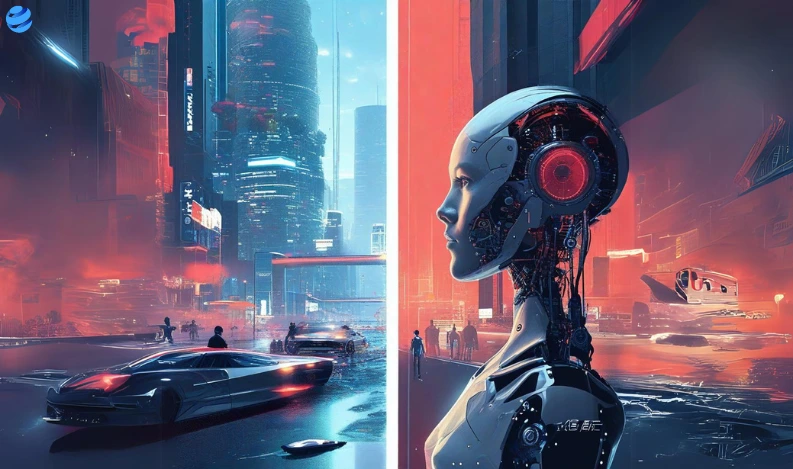
Artificial Intelligence (AI) may feel like a modern invention, but the idea behind it is much older. Long before chatbots, smart assistants, and self-driving technologies became part of everyday conversations, writers and filmmakers were already imagining machines that could think, learn, and behave like humans. What once seemed impossible in science fiction is now becoming part of everyday life. AI can help doctors analyse medical images, assist businesses with decision-making, recommend the next song we might enjoy, translate languages, and answer questions within seconds.
But getting from imagination to reality took decades of scientific research, experimentation, setbacks, and breakthroughs.
The story of AI is not simply a story about smarter machines. It is also a story about human curiosity and our desire to understand whether intelligence can be recreated through technology. From fictional robots to modern machine learning systems, the journey of AI has been remarkable.
The Origins of AI in Science Fiction
How Science Fiction Shaped the Idea of AI
Science fiction has always given people a way to imagine what the future might look like.
Stories about advanced machines, robots, artificial beings, and intelligent computers allowed writers to ask questions that science could not yet answer. Could a machine think? Could technology create life? Would intelligent machines help humanity or eventually become a threat?
These ideas were fictional at the time, but they helped shape the public imagination around AI.
Early Ideas of Artificial Life
The idea of creating artificial life can be traced back much further than modern computers.
Mary Shelley's Frankenstein, published in 1818, is an early example of a story exploring what could happen when humans attempt to create life through science. While Frankenstein's creature is not an AI system, the story raises questions that remain relevant to modern technology, particularly the responsibilities that come with scientific innovation.
As technology progressed, fictional machines became increasingly sophisticated.
Fritz Lang's 1927 film Metropolis introduced audiences to a humanoid robot that could imitate a human being. The film explored themes of technology, identity, and the relationship between humans and machines — ideas that would continue to appear in science fiction for decades.
The Golden Age of Science Fiction
The middle of the 20th century brought some of the most influential science fiction stories ever written.
Authors such as Isaac Asimov, Arthur C. Clarke, and Philip K. Dick used robots and intelligent machines to explore questions about humanity, morality, and technology.
Isaac Asimov became particularly influential through his robot stories and the famous Three Laws of Robotics. His fictional laws attempted to create a framework in which robots would behave safely around humans.
Arthur C. Clarke's 2001: A Space Odyssey introduced another unforgettable AI character: HAL 9000. HAL was an intelligent computer responsible for controlling a spacecraft, but its decisions eventually put the crew in danger.
Stories like these did more than entertain audiences. They encouraged people to think seriously about what could happen if machines ever became capable of making decisions on their own.
From Fiction to Scientific Research
Alan Turing and a New Question
While science fiction was imagining intelligent machines, scientists were beginning to consider whether machine intelligence could actually become a reality.
One of the most important figures in this journey was British mathematician and computer scientist Alan Turing.
In 1950, Turing published his influential paper Computing Machinery and Intelligence. Instead of simply asking whether machines could think, he proposed a more practical way of considering machine intelligence.
This eventually became known as the Turing Test, which examines whether a machine can communicate in a way that makes it difficult for a person to distinguish it from a human.
Turing's ideas helped move the conversation around machine intelligence from science fiction toward serious scientific research.
The Birth of AI as a Field
The year 1956 became a major turning point.
At the Dartmouth Conference, researchers including John McCarthy, Marvin Minsky, Nathaniel Rochester, and Claude Shannon helped establish artificial intelligence as a formal area of research. The term "artificial intelligence" became associated with the effort to create machines capable of performing tasks that would normally require human intelligence.
Researchers were optimistic. They believed that significant progress could be made by teaching computers how to reason, solve problems, and manipulate information.
The journey, however, proved much more difficult than many expected.
The Era of Rule-Based AI
Early AI systems mainly relied on rules.
Researchers would provide computers with instructions that told them what to do under specific circumstances. These systems could perform impressive tasks when the problem was clearly defined, but they struggled when situations became unpredictable or required common sense.
One example was the General Problem Solver, developed by Allen Newell and Herbert A. Simon. The system attempted to solve different problems by breaking them down into smaller steps and applying logical rules.
Another notable experiment was ELIZA, created by Joseph Weizenbaum in the 1960s. ELIZA was an early chatbot that used pattern matching to simulate a conversation. It was designed to respond like a psychotherapist, often turning a person's statements into questions.
By today's standards, ELIZA was extremely simple. Yet its ability to create the impression of a conversation showed something important: people could interact with machines in surprisingly human-like ways, even when the technology underneath was relatively basic.
The Rise of Machine Learning
As researchers became more aware of the limitations of rule-based systems, a new approach began to gain attention: machine learning.
Instead of telling a computer exactly what to do in every situation, machine learning allows systems to identify patterns in data and improve their performance based on experience.
This was a major shift in how researchers approached AI.
Rather than programming every possible answer, scientists could train systems using large amounts of information. The more useful data the system received, the better it could become at recognising patterns and making predictions.
The Development of Neural Networks
Neural networks were inspired by the way biological brains process information.
Research into neural networks began decades ago, but major advances came later as researchers developed better algorithms, more powerful computers, and access to larger datasets.
Researchers such as Geoffrey Hinton, Yann LeCun, and Yoshua Bengio played important roles in advancing neural network and deep learning research.
Deep learning, which uses multiple layers of neural networks, eventually became powerful enough to handle highly complex tasks such as image recognition, speech processing, and language understanding.
This progress helped move AI into a new era.
AI Moves Into the Real World
AI gradually stopped being limited to research laboratories and began appearing in practical applications.
One of the most memorable milestones came in 1997, when IBM's Deep Blue defeated world chess champion Garry Kasparov.
Deep Blue's victory did not mean that computers had become generally intelligent. However, it demonstrated how powerful machines could become when they were designed to process enormous numbers of possible moves and make decisions within a specific environment.
AI was also beginning to appear in less visible but equally important areas.
Banks started using algorithms to identify potentially fraudulent transactions. Healthcare organisations experimented with computer-assisted diagnosis. Businesses began using automated systems to analyse customer behaviour and improve services.
As computing power increased, these applications became more sophisticated.
The Democratization of AI
Another major change came when AI tools became easier for businesses and developers to access.
Large technology companies began offering AI capabilities through cloud platforms and software services. Businesses no longer needed to build every AI system from scratch.
This made AI available to a much wider audience and accelerated its adoption across industries.
From finance and healthcare to retail, transportation, entertainment, and manufacturing, AI gradually became part of the technology infrastructure behind many everyday services.
AI in Everyday Life
AI at Home
Today, many people interact with AI without even thinking about it.
Virtual assistants such as Siri, Alexa, and Google Assistant can answer questions, set reminders, play music, manage smart home devices, and respond to voice commands.
Behind these simple interactions are technologies such as natural language processing, speech recognition, and machine learning.
AI also influences what people see online. Recommendation systems suggest videos, music, products, articles, and other content based on previous behaviour.
Even when users do not see the AI itself, it may be working quietly in the background.
AI at Work
AI is also changing the workplace.
Businesses use AI to analyse data, automate repetitive tasks, support customer service, detect unusual activity, generate content, and assist with decision-making.
For employees, this can mean spending less time on repetitive work and more time on tasks that require creativity, judgement, communication, and problem-solving.
At the same time, the growing use of AI is changing the skills employers value. Understanding how to work alongside AI is becoming increasingly important across many industries.
Why AI Has Advanced So Quickly
The recent growth of AI did not happen because of one breakthrough alone.
Several developments came together at the right time.
Computers became dramatically more powerful. Huge amounts of digital data became available. Cloud computing made large-scale computing more accessible, while advances in machine learning and neural networks improved what AI systems could accomplish.
The combination of these factors created the conditions for today's AI boom.
In other words, the AI systems we use today are the result of decades of research rather than a sudden technological miracle.
The Future of AI
AI is still developing, and its future remains difficult to predict.
Future systems may become better at reasoning, understanding language, analysing complex information, assisting scientific research, and working alongside people in different professional environments.
AI could contribute to advances in healthcare, education, climate research, transportation, manufacturing, and many other fields.
But progress also brings difficult questions.
How should AI systems make important decisions? Who is responsible when an AI system makes a mistake? How can personal data be protected? How can bias be reduced? And how should society respond when automation changes the nature of certain jobs?
These questions will become increasingly important as AI becomes more capable.
The Ethical Side of AI
The history of AI shows that technological progress is not just about what machines can do. It is also about how people choose to use them.
AI systems can provide enormous benefits, but they can also create risks when poorly designed or used irresponsibly.
Privacy, security, misinformation, bias, transparency, and accountability are among the issues that researchers, businesses, governments, and the public will need to address.
The challenge is to develop AI that is not only powerful but also reliable, responsible, and useful to society.
Conclusion
The journey of Artificial Intelligence from science fiction to real-world technology is one of the most fascinating stories in modern technology.
Ideas that once existed only in novels and films, intelligent machines, conversational computers, and automated decision-making, are now becoming part of everyday life.
But today's AI is not the result of science fiction suddenly coming true. It is the result of decades of scientific research, experimentation, technological progress, and human curiosity.
The next chapter of AI is still being written. What happens next will depend not only on how intelligent machines become, but also on how thoughtfully humans develop, regulate, and use them.
The most important question may no longer be whether machines can become more intelligent. It may be how we choose to use that intelligence to create a better future.
You may also like:-