


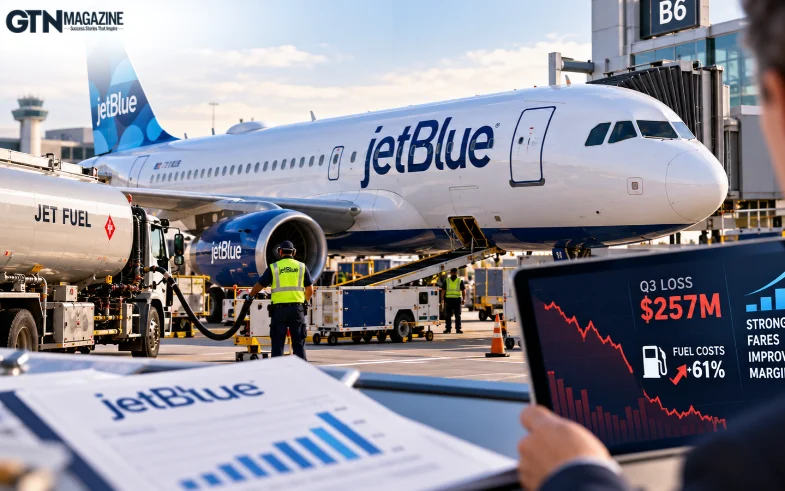
JetBlue Airways reported a wider third-quarter loss as soaring fuel prices increased operating expenses, but the US airline said stronger fares and resilient travel demand are helping it improve margins and advance its turnaround strategy.
The New York-based carrier reported a net loss of $257 million for the three months ended September 30, 2026, compared with a loss of $143 million in the same period last year. The results, released on October 26, highlight the pressure higher fuel costs are placing on airlines even as passenger demand remains relatively strong.
Chief Executive Officer Joanna Geraghty said revenue performance exceeded the company’s initial expectations, allowing JetBlue to recover more of its increased fuel expenses than anticipated.
Higher Fuel Prices Weigh on Quarterly Results
Fuel was a major factor behind JetBlue’s increased losses. The airline’s fuel bill rose 61% year over year to approximately $868 million during the quarter, while its average fuel price reached $3.91 per gallon, an increase of 57% from the previous year.
JetBlue reported an adjusted loss of 60 cents per share, compared with a loss of 40 cents per share a year earlier. The result was also worse than analysts’ expectations for an adjusted loss of 55 cents per share.
Despite the higher expenses, operating revenue increased 21.1% to approximately $2.81 billion. The airline attributed the improvement to stronger fares, effective revenue management and sustained demand across different travel periods.
The results illustrate the challenge facing JetBlue as it attempts to return to sustained profitability while managing inflationary operating costs and competition from larger carriers.
Higher Fares Help Offset Rising Costs
JetBlue said revenue per available seat mile, a key airline performance measure known as RASM, increased 18.4% year over year in the third quarter.
The improvement was supported by higher yields across both premium and standard travel offerings. The company also said its revenue management technology helped it capture better fares and respond more effectively to demand.
According to management, JetBlue recovered approximately 87% of the increase in fuel costs during the quarter. While that helped cushion the impact of expensive fuel, it was not enough to prevent the airline from reporting a larger overall loss.
The company’s performance also benefited from its expansion in Fort Lauderdale, Florida, where it is increasing destinations and flight frequencies. JetBlue plans to operate more than 150 peak daily departures from the airport this winter, approximately 39% more than a year earlier.
Turnaround Strategy Focuses on Better Margins
JetBlue is pursuing its JetForward strategy to strengthen revenue, improve operational efficiency and restore profitability. The plan includes better pricing and revenue management, expanded premium travel products, stronger customer loyalty and more disciplined capacity deployment.
Management expects adjusted operating margins to improve by one to two percentage points in the fourth quarter compared with the same period last year, despite forecasts that fuel prices will remain significantly higher.
The airline also expects costs excluding fuel to moderate, supporting its efforts to improve financial performance as it enters 2027.
JetBlue ended the third quarter with approximately $2.2 billion in liquidity, including an undrawn $600 million credit facility. The company also reported an unencumbered asset base of roughly $7 billion, providing additional financing flexibility.
However, financial pressure remains significant. The airline has continued to report losses, and concerns about its long-term financial position have added to investor uncertainty.
JetBlue Maintains Long-Term Profitability Targets
Despite the difficult quarter, JetBlue reaffirmed its goal of achieving sustained operating profitability in 2027. It also reiterated its target of generating at least $1 in earnings per share and positive free cash flow in 2028.
Achieving those targets will depend on the airline’s ability to maintain stronger fares, control costs and generate sufficient cash to support its operations and investment plans.
JetBlue’s latest results show that higher ticket revenue can help offset expensive fuel, but the company has yet to eliminate its underlying losses. The coming quarters will be important in determining whether its turnaround strategy can deliver lasting improvements.
For now, management is relying on stronger demand, premium offerings and operational discipline to narrow the gap between revenue growth and profitability while navigating continued uncertainty in the aviation market.
News Highlights:-