

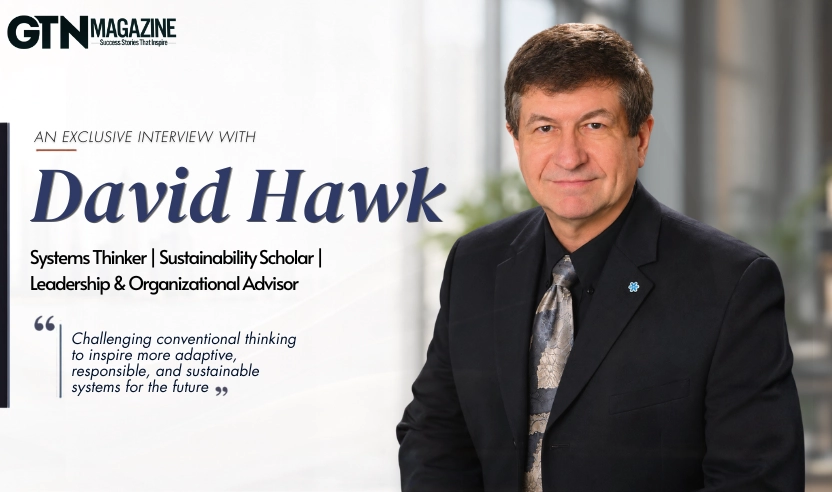
Some lives are shaped by following established paths. David Hawk’s has been defined by questioning who created those paths, whom they serve, and where they ultimately lead.
From working nights to finance his education and confronting authority during the Vietnam War to challenging conventional thinking in architecture, business, education, and environmental policy, Hawk has consistently refused to accept obedience as a substitute for integrity. His journey has taken him across countries, universities, corporations, and institutions, yet one principle has remained constant: meaningful progress begins when people are willing to question the systems surrounding them.
For more than five decades, Hawk has examined the relationship between human behaviour, business practices, climate change, and the limits imposed by nature. His work on “Business as Unusual,” his interdisciplinary academic journey, his unconventional approach to advising organisations, and his willingness to learn from students have made his career as provocative as it is distinctive.
In this feature, David Hawk reflects on the formative experiences that shaped his thinking, the institutional resistance he encountered, and the urgent questions that continue to guide his work. His story invites readers to look beyond conventional ideas of leadership, strategy, and sustainability, and to consider whether humanity is genuinely capable of changing before the consequences of remaining unchanged become unavoidable.
Learning to Question Before Learning to Conform
David Hawk grew up on a farm in Iowa, where he worked for his father until the age of 18. When he left home to attend college, his family could not contribute toward the cost. He therefore worked nights at UPS to pay for tuition and food, living inexpensively in the mechanical room of a church basement.
From an early age, Hawk learned not to place people on pedestals. Instead of searching for heroes, he observed individuals whose behaviour represented precisely what he did not want to become. This gradually shaped his instinct to question instructions, particularly when they came from people presenting themselves as leaders. One of his uncles advised him not to attend college, study electrical engineering, or enrol at Iowa State University. Because Hawk believed this uncle was wrong about most things, he chose to do all three.
His resistance to convention had already become visible during high school. He opposed a school initiative that encouraged students to “clean up” the county by killing animals considered pests or varmints. Hawk helped suspend the practice for a year, but the school leadership responded by excluding him from college preparatory courses. Required to spend those periods in the library, he began teaching himself mathematics, science, thermodynamics, and literature through books. What was intended as punishment ultimately left him better prepared for college than many of his classmates.
During his third year at Iowa State, Hawk accidentally entered the wrong lecture hall and heard an architecture professor discussing how building materials could encourage obedience. According to Hawk, the professor urged students to reject attractive natural materials in favour of rough and visually unappealing surfaces, such as exposed concrete, as a means of making people more compliant with authority. Appalled by the argument, Hawk transferred from electrical engineering to architectural engineering. He wanted to confront that way of thinking from within the discipline itself.
War, Conscience, and a Defining Refusal

Hawk’s change from a four-year degree programme to a five-year one brought him into conflict with his local draft board. He was informed that the transfer would not extend his draft exemption. He responded in characteristically blunt terms, telling the board that if it wanted him so badly, it should take him immediately. The board did exactly that, giving him only two weeks to report for duty.
Although Hawk believed the decision violated the applicable rules, the episode taught him that laws do not always govern what institutions decide to do. Following basic training and helicopter repair school, he was sent to Vietnam in early November 1966 and remained there until late March 1968.
One of the most consequential moments of his life came during the Tet Offensive in January 1968. Hawk was loading bodies into a helicopter when a captain told him to stop using government resources for that purpose and instead shoot people running over a distant hill. Hawk saw that they were women and children and refused. He told the captain that he would sooner shoot him, believing that doing so would make the world a better place.
Serious charges followed, including disobedience and threatening the life of a superior officer. A battlefield hearing was held that night to determine the appropriate punishment. Hawk remained silent for most of the proceedings. At the end, he described what leadership in Vietnam had become through a term of his own: “leadershit.” He then offered one sentence:
“We, the unwilling, led by the unqualified, to kill the unfortunate, die for the ungrateful.”
The panel ultimately recommended promotion rather than punishment. By 1971, the statement had become associated with youth protests against the Vietnam War. For Hawk, it captured a conviction that would continue to guide his life: authority does not absolve an individual of moral responsibility.
An Education Beyond the Classroom
Hawk returned from Vietnam experiencing considerable mental distress. He joined a motorcycle gang and travelled across the United States. Whenever he returned to Iowa, listening to Bob Dylan throughout the day and night became a form of personal therapy. Members of the motorcycle gang eventually persuaded him to complete his college degree.
Hawk remained deeply sceptical of conventional university education. Instead of limiting his learning to the classroom, he used university provisions to organise international semesters for himself and groups of 20 to 40 students. Under the applicable rules, he could use university funds to appoint faculty members for these programmes.
One semester took the group to Yucatán, Mexico, where they studied the anthropology of the Maya and the environmental consequences of agricultural practices between approximately 800 and 1200. Hawk later drew upon the experience as an early illustration of how human activity could alter climatic and ecological conditions.
For another semester, he organised a programme in Europe and hired a professor whose team was competing to design the facilities for the Munich Olympic Games. The professor’s approach to education differed significantly from the methods Hawk had encountered in the United States. After graduating, Hawk returned to Germany to work with him, and the professor’s team subsequently won the Munich competition.
The professor later recommended Hawk for a position as an architect and city planner in central London. There, Hawk became involved in a proposed redevelopment of Piccadilly Circus. Believing the project would damage the city while benefiting public officials and corporate interests, he worked to stop it rather than carry out instructions designed to please senior leadership. The project was halted, but Hawk was dismissed.
Edmund Bacon, one of the leading city planners of the period, had been observing the project. Bacon invited Hawk to join the University of Pennsylvania as his research assistant. Hawk accepted and pursued graduate studies in architecture and city planning while working alongside him.
After one semester, the architecture faculty voted to prevent Hawk from taking further architecture courses. He was allowed to remain at the university and receive joint degrees in architecture and city planning, but his coursework had to be completed elsewhere on campus. The restriction again became an unexpected opportunity. Hawk studied with innovative professors across engineering, communications, and the Wharton School.
Among these experiences was what Hawk describes as the first university course devoted to holography, taught by one of the field’s developers. His interdisciplinary path eventually brought him into contact with Russell Ackoff, one of the era’s leading thinkers in systems and business education. When Ackoff established a new doctoral programme in Social Systems Sciences in 1974, he invited Hawk to become its first student.
Hawk ultimately earned master’s degrees in architecture and city planning, followed by a PhD in Social Systems Sciences. Unable to secure funding in the United States for research into how prevailing business practices were contributing to environmental deterioration, he moved to the Stockholm School of Economics to continue the work.
Searching for “Business as Unusual”

In Stockholm, Hawk worked with two Swedish colleagues to establish the Institute of International Business. The institute was created to support a search for what they called “Business as Unusual”, an alternative to practices that prioritised immediate commercial gain while overlooking their wider environmental consequences.
The institute brought together prominent Swedish business leaders to serve on its board and initially raised approximately $10 million, followed by additional funding. Its first major undertaking was an international project titled Environmental Protection: Analytic Solutions in Search of Synthetic Problems. The study examined environmental deterioration caused by business activities and involved 20 companies and six governments.
According to Hawk’s research account, Exxon’s CEO and senior research leadership asked to participate in the study. At that time, they argued that companies had a responsibility to address the human consequences of environmental deterioration and frequently used the phrase “climate change.” By 1978, senior figures associated with the company were speaking publicly about the importance of climate change to the future of life on Earth. Hawk says their positions later brought them into conflict with the company’s board.
The research produced three reports in 1977. In 1979, Hawk’s dissertation was published through the University of Pennsylvania and the Wharton School under the title Regulation of Environmental Deterioration. Its arguments were controversial at the time, but the work was presented to President Jimmy Carter.
Four decades later, Hawk revised and republished the work as Too Early, Too Late, Now What? in 2019. A second edition appeared in 2022 and, according to the material he supplied, was placed in the Library of Congress through the office of then Vice President Kamala Harris. Hawk has since written several additional books examining climate change, business, and human behaviour.
Letting Students Redesign Business Education
Hawk began teaching about the consequences of climate change in relation to human enterprise in 1976 and continued doing so for approximately 30 years. His work repeatedly challenged accepted models of business education, particularly those that treated growth, control, and strategic advantage as unquestionable priorities.
In 2005, he became dean of a business school that was on probation and at risk of closure. Rather than imposing a conventional recovery plan, he invited students to help determine what the school should become and how it could better serve society. Classes were suspended for two days so that students and faculty could examine the future of the institution. The Chief of Staff of IBM International chaired the discussions.
Faculty members became increasingly uncomfortable with the students’ involvement, and many withdrew from the second day. At one point, a banner appeared declaring, “If students knew anything, they would not be here.” The students answered with a sign of their own: “You are right.”
With the support of IBM’s Chief of Staff, the students produced a report proposing significant changes to business education. One suggestion was an executive PhD programme through which experienced CEOs could study at the university while teaching students what they had learned in professional life. Similar programmes were later introduced at several prominent institutions.
The students’ report contributed to the school obtaining full accreditation. The international accrediting organisation AACSB subsequently recognised it as “The Most Improved School of Business in North America.” Hawk states that the university president dismissed him as dean approximately four hours after the recognition was announced because senior leadership had not been sufficiently involved in obtaining it.
Despite the conflict, Hawk considers the experience one of the most meaningful achievements of his career. It reinforced his belief that educators should learn from students rather than treat education as the one-directional delivery of established answers.
Advising Without Becoming a Consultant
Hawk is proud that he has never regarded himself as a corporate consultant. He has worked only as an advisor, a distinction he considers essential. In his view, a paid consultant is often expected to remain agreeable, while a genuine advisor must retain the freedom to confront a CEO whose conduct is damaging the organisation.
He does not personally retain the fees generated through his advisory work. Instead, the money is directed to several charities he supports. A Wall Street Journal article cited in his materials described his role in advising a company as it expanded from approximately $30 billion to $300 billion in annual revenue. Hawk’s guidance emphasised preparing the organisation for the consequences of climate change rather than relying solely on established approaches to growth.
In 2003, Hawk received the IBM International Professor of the Year recognition, accompanied by a monetary award of $30,000. According to Hawk, the university where he was employed redirected the money for institutional purposes. After a prolonged conflict involving five court cases, the university president ultimately dismissed him from his professorial position.
Recognition and resistance have therefore remained closely connected throughout Hawk’s career. His ideas have attracted awards, corporate attention, and international interest, yet the same ideas have frequently placed him at odds with institutional authority.
When Hope Gave Way to a Warning
In 1979, Hawk still held considerable hope that human beings would transform prevailing models of management and business before the consequences of climate change became irreversible. By 2017, much of that hope had disappeared.
His 2022 book, Sorry, Humans Are Fucked, argued that life on Earth was approaching a sixth mass extinction, the first, in his view, to be caused by human beings. In The Climate Is Changing, Can Humans?, published in 2025, he examined the limitations that repeatedly prevent people from changing their conduct even after recognising the dangers ahead.
The central question behind the book is not whether the climate is changing, but whether humanity is capable of changing with it. Hawk’s work treats climate change as more than an environmental or scientific problem. It is also a reflection of how people relate to nature, one another, authority, technology, and the possibility of their own mortality.
In 2026, work began on adapting the ideas in The Climate Is Changing, Can Humans? into a 12-part documentary series. The proposed production is intended to translate more than five decades of research into visual storytelling, combining climate science with questions about leadership, systems, emotion, imagination, and human behaviour.
The project follows a 59-week, Google-sponsored television series Hawk ran during 2024 and 2025. According to Hawk, the programme was discontinued after he used a provocative image of a naked Donald Trump, presented as a leader, to illustrate what he believed was happening to the United States.
Replacing Changelessness with Fluid Enterprise
Hawk encourages people within organisations to resist the tendency to equate leadership with changelessness. He believes that conventional hierarchies often preserve authority long after circumstances have changed, preventing institutions from responding intelligently to the world around them.
Instead, he advocates for fluid enterprises guided by values that help people develop, adapt, and care for meaningful forms of “Business as Unusual.” He traces modern hierarchy partly to traditions inherited from religious institutions and political systems, where power is protected through rank, control, and obedience.
For Hawk, the need to pursue change has become more urgent than the continued pursuit of money. Life is limited, and he sees greed as a waste of that limitation. Organisations should therefore move beyond rigid command structures toward negotiated order, self-regulation, and networks capable of responding to context.
This philosophy also shapes his understanding of education. Traditional schooling frequently asks students to memorise established answers to inherited questions. Genuine learning, he argues, begins when people examine the questions themselves, challenge what has been accepted, and remain willing to discover that their assumptions are wrong.
Entropy and the Limits of Human Strategy
Two interconnected ideas run through much of Hawk’s writing and advisory work. The first is that human beings must examine entropy rather than attempt to hide from it. Since the nineteenth century, scientists have recognised the Second Law of Thermodynamics as a central law of the universe, one that cannot be violated or reversed.
Nevertheless, Hawk believes the desire to reverse entropy, commonly described as “negative entropy” or “negentropy,” has become a defining human ambition. He sees this impulse across industrial development: first in machines, then in the treatment of people, and now in claims made about artificial intelligence.
In his analysis, advertising, marketing, and strategic thinking frequently promise forms of permanence, control, or continuous advancement that natural laws do not allow. His argument that entropy makes “sustainability” impossible is not a call for indifference. Rather, it is a challenge to abandon the fantasy of keeping systems unchanged forever and begin creating forms of enterprise that can live with transformation, deterioration, and uncertainty.
Hawk is equally critical of strategy as it is commonly taught in business schools. Referencing Carl von Clausewitz, he describes strategy as a form of deceit used to secure success. When marketing and strategy normalise manipulation, short-term advantage, and the concealment of consequences, he believes they become counterproductive to the longer-term interests of life.
Artificial intelligence, from Hawk’s perspective, extends the same industrial logic. He questions both its energy demands and its dependence on formal, Aristotelian reasoning. Natural intelligence is contextual, emotional, relational, and capable of living with uncertainty; artificial systems, he argues, risk narrowing intelligence to what can be processed, measured, and controlled.
His challenge to humanity is therefore both philosophical and practical: stop promising permanence in a universe defined by change, stop confusing control with intelligence, and stop treating technological advancement as an escape from natural consequence.
The question with which Hawk leaves his readers is characteristically direct:
“Humans: Where lies the hope? Probably not in more lies.”
Conclusion
David Hawk’s journey is not a conventional account of leadership, achievement, or institutional recognition. It is the story of a man who has spent decades questioning the structures that society is often encouraged to accept without challenge. From resisting authority during his youth and military service to confronting established thinking in education, business, and environmental policy, he has repeatedly chosen conscience over compliance.
His work also reveals a deeper concern: humanity’s persistent attempt to preserve systems that were never designed to endure. Through “Business as Unusual,” his examination of entropy, and his criticism of hierarchy, strategy, and unchecked technological ambition, Hawk challenges organisations to abandon the illusion of permanence and become more responsive to change, consequence, and the limits of nature.
Although his confidence in humanity’s willingness to change has diminished over time, Hawk continues to ask the questions that institutions, corporations, and individuals often prefer to avoid. His journey reminds readers that meaningful learning does not begin with inherited answers, but with the courage to reconsider the questions, and to recognise when accepted ways of thinking are no longer sufficient.
Ultimately, Hawk’s story leaves humanity facing an uncomfortable but necessary choice: continue defending familiar systems until change is forced upon us, or confront difficult truths while there is still an opportunity to respond. The climate is changing. Whether humans can change remains the defining question.
You may also like:-