

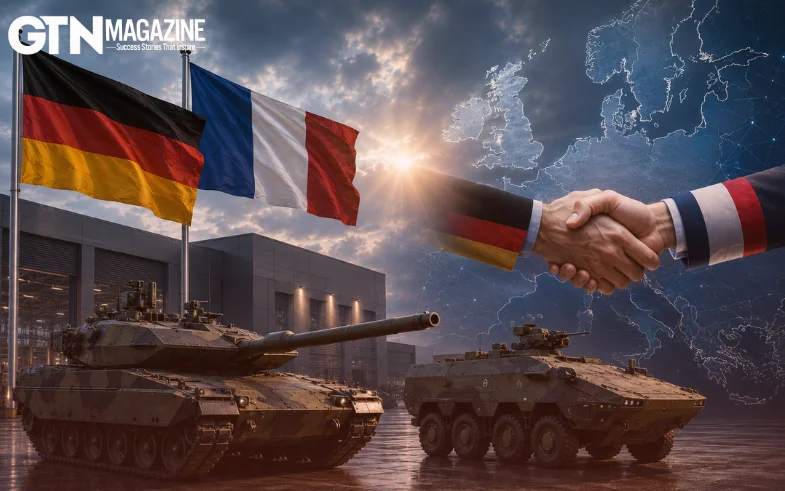
Germany announced Monday that it intends to acquire a 40% stake in KNDS, the Franco-German defence group behind the Leopard battle tank, in a move aimed at strengthening European military manufacturing capabilities and securing long-term influence over one of the continent's most strategically important defence companies.
The investment will make Germany a major state shareholder alongside France, which already holds a 50% stake in the company. The remaining shareholding is currently owned by the German family behind Krauss-Maffei Wegmann (KMW), one of KNDS's founding companies, whose planned exit has paved the way for Berlin's entry.
The move comes as European governments accelerate defence spending and seek to expand military production capacity amid continuing security concerns linked to Russia's war in Ukraine and growing uncertainty about the future role of the United States in European security.
German officials described the acquisition as a strategic investment designed to safeguard critical defence technologies, strengthen industrial capabilities, and protect national security interests.
"Germany's participation will secure long-term influence over a company that is essential to European security and defence," the government said in a statement.
KNDS was created in 2015 through the merger of German defence manufacturer Krauss-Maffei Wegmann and French defence company Nexter. Since then, it has become one of Europe's leading defence contractors, producing a range of military equipment used by NATO and allied forces.
The company is best known for manufacturing the Leopard battle tank, one of the most widely deployed main battle tanks in Europe. KNDS also produces the Leclerc tank, the Puma infantry fighting vehicle, and the Boxer and Dingo armoured personnel carriers.
Demand for the company's products has increased significantly as European nations seek to replenish military inventories following years of underinvestment and extensive military support provided to Ukraine.
According to company figures, KNDS generated approximately €4.4 billion in revenue last year and employs more than 11,000 people across its operations.
Germany and France said they have reached an agreement regarding the future governance and strategic direction of the company, with both governments aiming to maintain equal influence over the business through balanced ownership arrangements.
The announcement also clears the way for a potential stock market listing of KNDS in the coming years.
While neither government disclosed a specific timetable, officials indicated that the agreement establishes a framework for a future public offering. According to individuals familiar with the discussions, Germany and France could reduce their stakes to around 30% each within two to three years following a listing while maintaining equal voting rights.
The two governments presented the agreement as part of a broader commitment to strengthening Europe's defence industrial base and enhancing the continent's strategic autonomy.
The concept of state participation in KNDS was first proposed by German Defence Minister Boris Pistorius in 2025 as a mechanism for preserving critical defence expertise, safeguarding jobs, and ensuring long-term control over strategically important technologies.
The latest move reflects a wider trend across Europe, where governments are taking a more active role in defence industries amid rising geopolitical tensions and growing demand for military equipment.
As Europe continues to invest heavily in defence modernization, KNDS is expected to play a central role in supplying advanced military systems to European armed forces, reinforcing its position as one of the region's most important defence manufacturers.
More News:-