

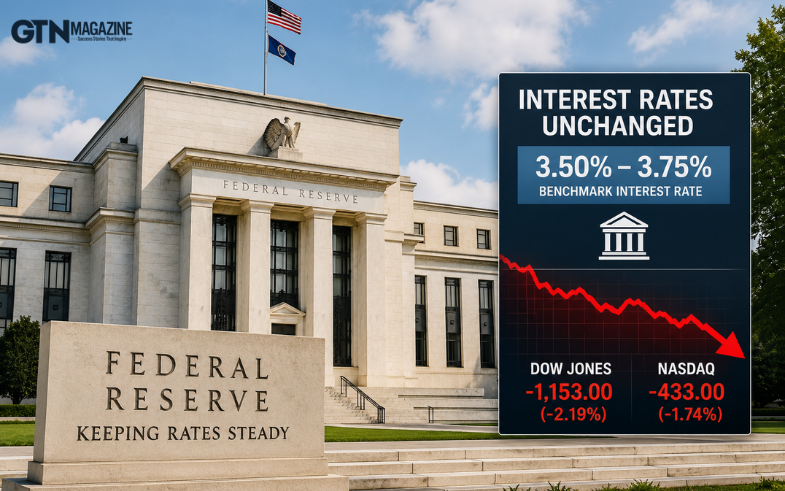
The U.S. Federal Reserve left its benchmark interest rate unchanged on Wednesday, maintaining the federal funds rate at 3.5% to 3.75%, as policymakers weighed persistent inflation against the need to support economic growth.
The decision triggered a broad sell-off on Wall Street, with investors reacting to the central bank's cautious stance and fading expectations for near-term rate cuts ahead of the U.S. midterm elections.
The Dow Jones Industrial Average dropped 1,153 points, or 2.19%, while the Nasdaq Composite fell 433 points, or 1.74%, reflecting growing uncertainty over the direction of U.S. monetary policy.
The Federal Open Market Committee (FOMC) voted 9-3 to keep interest rates unchanged. Three policymakers, including Minneapolis Federal Reserve President Neel Kashkari, supported a quarter-percentage-point rate hike, highlighting divisions within the central bank over how best to address inflation.
Federal Reserve Chair Kevin Warsh described the differing views among policymakers as a "good family fight," emphasizing that the debate centered on balancing inflation control with sustaining employment and economic expansion.
Warsh, who assumed leadership of the Federal Reserve in May, reaffirmed the central bank's commitment to restoring inflation to its long-term target of 2%.
"I do not believe that price stability and full employment is an either-or proposition," Warsh said after the policy meeting, adding that the Fed would act when necessary to achieve its dual mandate.
The latest Consumer Price Index (CPI) data showed annual inflation rising to 3.5% in June, reinforcing concerns that price pressures remain elevated despite previous monetary tightening.
President Donald Trump, who has repeatedly advocated lower borrowing costs, defended Warsh following the decision while acknowledging that the Federal Reserve's policymaking process rests with the broader committee.
"I know he'd love to see lower interest rates, but he's got a board, and it's a political board, and they want to keep rates up," Trump told reporters at the White House.
The September FOMC meeting will be the final policy meeting before November's midterm elections and is expected to be closely watched by investors for signals on the future path of interest rates.
Financial markets are likely to remain sensitive to upcoming inflation and employment data, which could influence whether the Federal Reserve maintains its current policy stance or adjusts interest rates later this year.
Must Read:-