


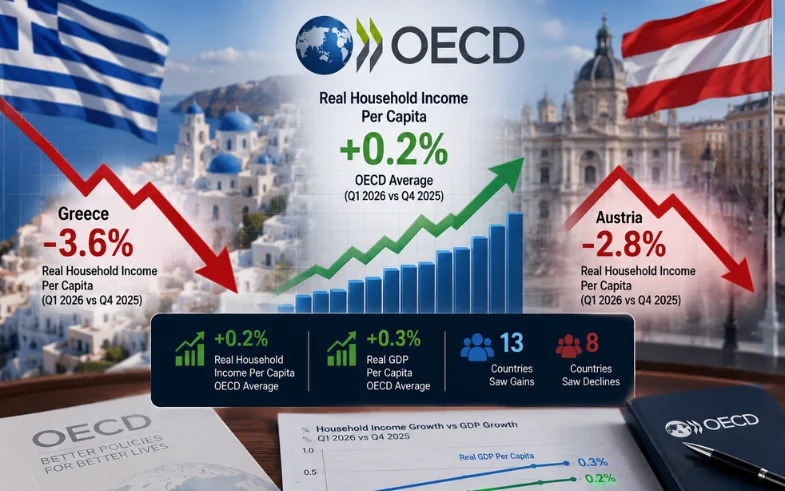
Household income across the OECD continued to grow in the first quarter of 2026, but the improvement was modest and uneven, with Greece and Austria recording the steepest declines among countries covered by the latest data.
Real household income per capita rose by 0.2% across the OECD during the first three months of the year, slowing from a 0.6% increase in the final quarter of 2025.
At the same time, real GDP per capita increased by 0.3%, highlighting a growing difference between overall economic expansion and the financial position of households.
While GDP measures the broader performance of an economy, household income provides a clearer indication of the resources available to individuals and families for spending or saving.
Greece Records Largest Household Income Decline
Greece experienced the sharpest fall among the countries included in the latest figures.
Real household disposable income per capita declined by 3.6% compared with the previous quarter.
The drop was largely linked to lower net property income, including returns from interest, dividends and other investments, as well as weaker net social benefits received by households.
The decline marked a significant reversal after household income had improved in the previous quarter.
Austria recorded the second-largest contraction, with real household income per capita falling by 2.8%.
Majority of OECD Countries Still Record Growth
Among the 21 countries for which figures were available, 13 reported an increase in real household income per capita, while eight recorded declines.
The mixed performance shows that broader economic growth is not translating evenly into stronger household finances.
Inflation, taxation, social benefits, employment income and investment returns all played a role in shaping household purchasing power across individual economies.
Italy Leads Improvement Among Major European Economies
Among G7 countries, Italy recorded one of the strongest improvements.
Real household income per capita increased by 0.8% in the first quarter after falling 0.9% in the previous three-month period.
Higher employee compensation supported the recovery, helped by a decline in Italy’s unemployment rate from 5.7% to 5.4%.
Real GDP per capita in Italy increased by 0.3%.
Canada, Germany and the United States each recorded a 0.2% increase in household income per capita.
UK Household Income Drops Despite GDP Growth
The United Kingdom moved in the opposite direction.
Real household income per capita declined by 0.8% after increasing by 1.1% in the previous quarter.
The fall was linked to higher taxes on income and wealth, lower net social benefits and continued inflationary pressure.
The decline came despite a 0.6% increase in real GDP per capita, reinforcing the gap between headline economic growth and household financial conditions.
France also recorded a slight decline, with household income per capita falling by 0.1%.
Hungary and Chile Post Strong Gains
Outside the G7, Hungary recorded the strongest rise in household income.
Real household income per capita jumped 6% in the first quarter, supported by a 6.3% increase in employee compensation.
The increase significantly outpaced Hungary’s 0.9% growth in real GDP per capita.
Chile also posted a strong performance, with real household income per capita increasing by 4.8%.
Higher earnings for employees and self-employed workers, together with stronger net property income, contributed to the increase.
Household Prosperity Remains Uneven
The latest figures underline the importance of looking beyond GDP when assessing economic conditions.
Although economic activity across the OECD continues to expand, household finances remain under pressure in several countries.
For consumers, changes in wages, inflation, taxation, investment income and government support can have a more immediate effect on living standards than headline economic growth.
The sharp declines in Greece and Austria show that stronger national economic output does not automatically result in improved financial conditions for households.
Must Read:-