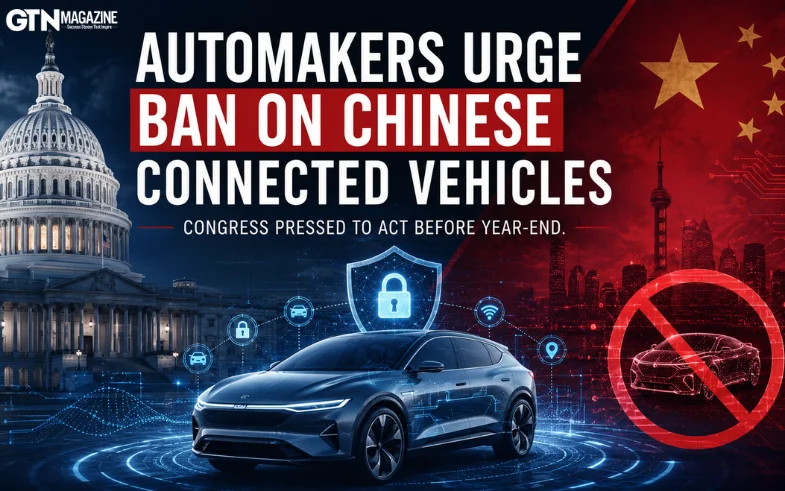
Major automakers operating in the United States are urging Congress to move quickly on legislation that would permanently block Chinese connected vehicles, software and key hardware from the American market.
The Alliance for Automotive Innovation, which represents major manufacturers including General Motors, Ford, Toyota, Volkswagen, Hyundai, Honda and Stellantis, has called on congressional leaders to pass the restrictions before the current congressional session ends. The industry group says the issue is not only about competition, but also about national and economic security.
Automakers Raise National Security Concerns
The industry's main concern is the technology built into modern connected vehicles.
Today's cars can collect and transmit large amounts of information through cameras, sensors, navigation systems and internet-connected software. Automakers and U.S. lawmakers fear that vehicles linked to Chinese companies could potentially be used to collect sensitive data from American roads and communities.
The Alliance for Automotive Innovation argues that China's heavily subsidized auto industry is rapidly expanding into markets around the world with increasingly connected vehicles. The group wants the U.S. to act before Chinese manufacturers establish a significant presence in the American market.
Bipartisan Bill Already Moving Through Congress
The push comes as Congress considers the Connected Vehicle Security Act of 2026, a bipartisan proposal introduced by Senators Elissa Slotkin and Bernie Moreno.
The legislation would restrict Chinese vehicles as well as related software and hardware at multiple stages, including manufacturing, importation and sale. The bill received unanimous support when it advanced through the Senate Commerce Committee in July.
Supporters say the legislation would create a permanent legal framework instead of relying mainly on executive or regulatory actions.
Industry Wants Action Before Year-End
Automakers are asking lawmakers to complete the legislation before the end of the current congressional session.
The Alliance for Automotive Innovation says waiting could give Chinese manufacturers more time to expand their global market share and develop deeper relationships with suppliers and technology companies. The group specifically wants Congress to close potential exemptions that could allow companies such as BYD, Chery and SAIC Motor to enter the U.S. market.
The industry argues that acting now would give American manufacturers greater certainty while protecting the domestic automotive supply chain.
Concerns Over the Scope of the Ban
The proposed restrictions have also raised questions about how broadly the law should apply.
Some lawmakers have warned that a sweeping definition of Chinese ownership could unintentionally affect companies with partial Chinese investment or international ownership structures. Senator Ted Cruz, chairman of the Senate Commerce Committee, has previously indicated that changes may be needed to avoid unintended consequences.
That debate could make the final legislation more complicated, particularly as global automakers increasingly rely on international supply chains.
China Pushes Back
China has criticized Washington's approach, arguing that restrictions on Chinese vehicles could undermine fair competition and limit consumer choice.
Beijing has also defended its auto industry as part of a competitive global market. Chinese manufacturers, meanwhile, are rapidly expanding overseas, with companies such as BYD becoming increasingly prominent in Europe, Southeast Asia and other markets.
The U.S. is already taking a tougher approach toward China-linked vehicles. Swedish EV maker Polestar, which is majority-owned by China's Geely Holding, recently reduced its delivery outlook after U.S. restrictions forced it to exit the American market.
A Bigger Battle Over the Future of Cars
The debate over Chinese connected vehicles reflects a much larger shift in the global auto industry. Cars are increasingly becoming software-driven devices, making questions about data, cybersecurity and foreign technology just as important as traditional concerns about manufacturing and trade.
For American automakers, the proposed ban could reduce the threat from heavily subsidized Chinese competitors. For consumers, however, fewer international competitors could mean less choice in the U.S. market.
Congress now faces the challenge of balancing national security, economic competition, consumer choice and technological innovation as it considers whether to make the restrictions permanent.
News Highlights:-