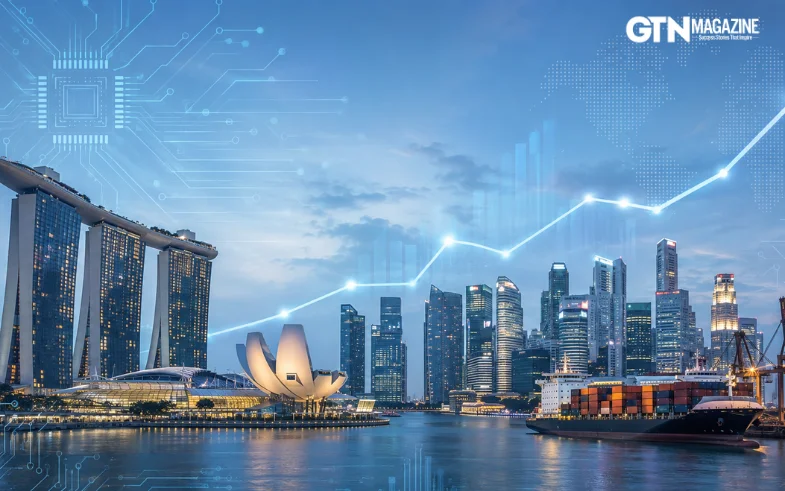
Singapore has sharply raised its economic growth forecast for 2026 after stronger-than-expected activity in the first half of the year, with booming global demand for artificial intelligence technology providing a significant lift to manufacturing and exports.
The Ministry of Trade and Industry now expects the city-state’s economy to expand by 4.5% to 5.5% this year, up from its previous forecast of 2% to 4%. At the beginning of 2026, officials had projected growth of just 1% to 3%.
The latest upgrade follows a stronger reading for the second quarter, when Singapore’s gross domestic product expanded 5.9% year-on-year, slightly above the earlier estimate of 5.7%.
Economic growth for the first half of 2026 reached approximately 6.1%, according to the latest government figures.
AI demand drives manufacturing growth
Singapore has emerged as one of the major beneficiaries of the global surge in spending on artificial intelligence infrastructure.
Demand for semiconductors, semiconductor manufacturing equipment and other electronics used in AI systems has supported the country’s technology-related industries and trade.
Earlier government data showed the manufacturing sector expanding strongly in the second quarter, led by the electronics and precision engineering clusters amid robust AI-related demand.
Manufacturing, wholesale trade and the finance and insurance sector were among the main contributors to second-quarter economic growth.
The strength of the technology cycle has also improved Singapore’s export outlook.
Enterprise Singapore has raised its forecast for non-oil domestic exports as global investment in AI infrastructure continues to support electronics demand. The latest outlook cited by Reuters expects key exports to grow 14% to 16% in 2026.
The performance reinforces Singapore’s role in global semiconductor and technology supply chains at a time when companies worldwide are investing heavily in data centers, AI processors and advanced computing infrastructure.
Middle East impact less severe than feared
Singapore’s improved outlook also reflects a smaller-than-expected economic impact from the conflict in the Middle East.
Earlier in the year, the government had warned that the regional conflict could weigh on growth by pushing up energy costs and disrupting supply chains.
However, the Ministry of Trade and Industry said the effects have so far been less severe than initially anticipated.
Drawdowns in oil inventories and the use of alternative energy supplies have helped contain the rise in global energy prices, reducing some of the pressure on Singapore, which depends heavily on imported energy.
The economy has also remained resilient despite new trade risks, including higher U.S. tariffs affecting some Singapore exports.
Inflation remains in focus
The stronger economic backdrop comes as the Monetary Authority of Singapore closely monitors inflation.
Singapore’s core inflation, which excludes accommodation and private transportation costs, rose to 1.6% in June, while headline inflation stood at 1.9%. Government data also showed the overall consumer price index rising 1.9% year-on-year in June.
The central bank unexpectedly tightened monetary policy in late July as policymakers warned that imported costs could increase in the coming quarters.
Higher fuel prices, more expensive electronic inputs and weather-related disruptions affecting food-producing countries remain among the inflation risks facing the economy.
The combination of stronger-than-expected growth and rising price pressures could give policymakers greater room to maintain a tighter monetary stance while assessing whether inflation remains under control.
Singapore benefits from global AI investment cycle
The upgraded forecast highlights how significantly the global AI investment boom is influencing economies linked to semiconductor manufacturing and advanced technology supply chains.
Singapore hosts major semiconductor producers, equipment suppliers, cloud infrastructure providers and regional headquarters for global technology companies.
As businesses continue investing heavily in AI computing capacity, demand has spread beyond processors themselves to manufacturing equipment, memory products, networking hardware, data-center infrastructure and related services.
That wider investment cycle has strengthened Singapore’s externally oriented economy.
The Monetary Authority of Singapore said in July that the technology sector was continuing to expand at an above-normal pace and was expected to account for a substantial portion of the country’s growth in 2026.
Risks remain despite stronger outlook
Despite the improved forecast, officials remain cautious about the sustainability of the current momentum.
A slowdown in global AI investment could weaken semiconductor demand, while renewed geopolitical tensions, higher energy prices or escalating trade restrictions could affect Singapore’s export-dependent economy.
Singapore is particularly exposed to shifts in global trade because external demand accounts for a significant part of its economic activity.
Still, the latest numbers represent a substantial improvement from expectations at the beginning of the year.
With growth now forecast at as much as 5.5% in 2026, Singapore is entering the second half of the year with significantly stronger momentum than policymakers had initially anticipated.
For now, resilient global demand for AI-related products, expanding technology investment and stronger domestic sectors are providing the city-state with a powerful economic tailwind.
Must Read:-