Artificial intelligence is no longer a futuristic concept discussed only within technology companies or research labs. It has rapidly become one of the most influential forces shaping modern business operations across industries worldwide.
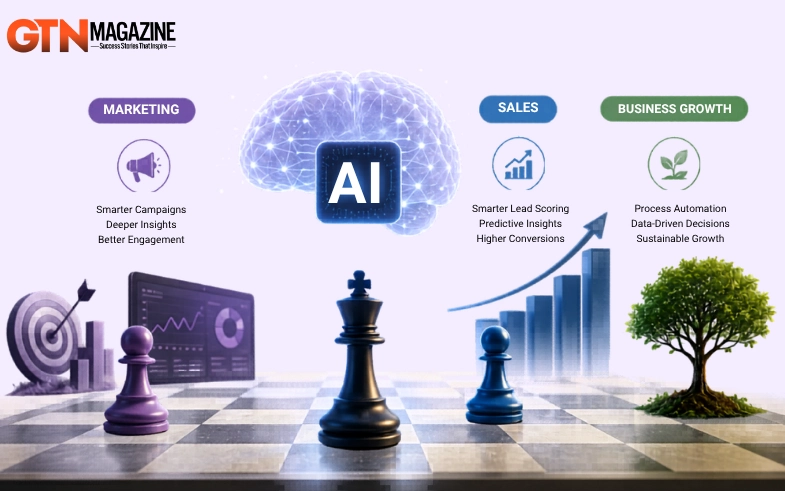
From marketing campaigns and customer engagement to sales strategies and operational decision-making, AI is transforming how businesses connect with audiences, generate revenue, and scale growth in increasingly competitive markets.
What makes this transformation particularly significant is the speed at which AI is evolving. Businesses that once relied heavily on manual processes, broad advertising strategies, and traditional sales models are now adopting intelligent systems capable of analyzing behavior, automating workflows, predicting trends, and improving customer experiences at scale.
As industries continue becoming more digital and data-driven, artificial intelligence is no longer simply a technological advantage. It is becoming a central part of modern business strategy.
AI Is Reshaping Modern Marketing
Marketing has experienced one of the biggest transformations through artificial intelligence.
Traditional marketing often relied on broad audience targeting, generalized messaging, and time-consuming manual analysis. Today, AI is allowing businesses to create far more personalized, efficient, and data-driven marketing strategies.
Modern consumers expect brands to understand their preferences, behaviors, and interests. Artificial intelligence helps businesses analyze massive amounts of customer data to deliver more relevant experiences.
AI-powered systems are now helping companies:
- Understand customer behavior
- Predict buying patterns
- Personalize recommendations
- Optimize advertising campaigns
- Improve audience targeting
- Automate marketing workflows
This level of personalization is becoming increasingly important in digital environments where consumers are exposed to enormous amounts of online content every day.
Businesses capable of delivering more relevant and personalized experiences are often able to strengthen customer engagement and improve long-term loyalty.
Personalization Is Becoming a Competitive Advantage
One of the most important ways AI is influencing marketing is through advanced personalization.
Consumers today no longer respond as strongly to generic advertising. They increasingly expect businesses to provide experiences tailored to their interests and behavior.
Artificial intelligence helps companies personalize:
- Product recommendations
- Email marketing campaigns
- Website experiences
- Content suggestions
- Customer communication
- Advertising strategies
Platforms such as e-commerce websites, streaming services, and social media networks already rely heavily on AI-driven personalization systems to keep users engaged.
This shift is changing how brands communicate with audiences. Businesses are moving away from mass marketing and toward more individualized customer experiences designed around behavior and preferences.
Over time, personalization is likely to become one of the most important factors influencing customer retention and purchasing decisions.
AI Is Improving Marketing Efficiency
Marketing teams today manage enormous amounts of data, content, advertising, and customer interaction across multiple digital platforms.
Artificial intelligence is helping businesses improve efficiency by automating many repetitive marketing tasks that previously required significant manual effort.
AI tools now assist with:
- Campaign optimization
- Content analysis
- Audience segmentation
- Ad performance tracking
- Customer engagement monitoring
- Social media scheduling
This allows marketing professionals to focus more on strategy, creativity, and long-term brand development rather than repetitive operational work.
Businesses using AI effectively are often able to launch campaigns faster, analyze results more accurately, and adapt strategies more quickly in competitive markets.
AI Is Transforming the Sales Process
Sales environments are also changing dramatically because of artificial intelligence.
Traditional sales strategies often depended heavily on manual lead generation, broad outreach, and time-intensive customer research. AI is now helping sales teams operate more strategically and efficiently.
Modern AI systems can analyze customer data and identify:
- Purchasing behavior
- Buying intent
- Customer preferences
- Lead quality
- Sales opportunities
This helps businesses prioritize stronger leads and improve sales conversion rates.
AI-powered customer relationship management systems are also helping organizations automate communication, track customer interactions, and improve follow-up processes.
As a result, sales teams are becoming more data-driven and better equipped to make informed decisions throughout the customer journey.
Predictive Analytics Is Changing Business Decision-Making
One of the most powerful aspects of artificial intelligence is predictive analysis.
Businesses today generate enormous amounts of data, but raw data alone has limited value without intelligent interpretation. AI helps organizations identify patterns and trends that would be difficult to recognize through manual analysis alone.
Predictive AI systems are helping companies forecast:
- Customer behavior
- Market demand
- Sales performance
- Inventory requirements
- Consumer trends
- Financial risks
This ability to anticipate future outcomes allows businesses to make more proactive and strategic decisions.
Companies that rely on predictive insights are often better prepared to respond to market changes and evolving customer expectations.
Customer Experience Is Becoming More Intelligent
Customer experience has become one of the most important factors influencing business growth.
Consumers now expect faster communication, instant responses, and seamless digital interactions. Artificial intelligence is helping businesses meet these expectations more effectively.
AI-powered systems such as chatbots and virtual assistants are improving customer support by providing:
- Instant responses
- 24/7 availability
- Faster problem resolution
- Personalized recommendations
- Automated assistance
While human interaction remains important, AI is helping businesses handle routine inquiries more efficiently while allowing customer support teams to focus on more complex situations.
This combination of automation and human service is becoming increasingly common across industries.
AI Is Helping Businesses Scale Faster
Scalability has always been one of the biggest challenges for growing businesses.
As companies expand, managing operations, marketing, customer engagement, and sales processes becomes increasingly complex. Artificial intelligence helps organizations scale more efficiently by reducing operational pressure and improving workflow automation.
AI-driven systems help businesses:
- Handle larger customer volumes
- Improve operational speed
- Automate repetitive processes
- Reduce human error
- Analyze performance data quickly
For startups and growing businesses, AI tools are becoming particularly valuable because they provide access to capabilities that previously required much larger teams and budgets.
This accessibility is helping smaller businesses compete more effectively in digital markets.
Human Creativity Still Matters
Despite rapid advancements in artificial intelligence, human creativity and strategic thinking remain essential.
AI can analyze data, automate workflows, and optimize performance, but it cannot fully replace human qualities such as:
- Creativity
- Emotional intelligence
- Storytelling
- Relationship-building
- Leadership vision
The businesses most likely to succeed are not necessarily those replacing people with AI, but those learning how to combine human strengths with intelligent technology effectively.
Successful companies are increasingly using AI to support human decision-making rather than eliminate human involvement entirely.
Ethical and Responsible AI Will Become Increasingly Important
As AI adoption grows, businesses are also facing important ethical considerations.
Consumers are becoming more aware of:
- Data privacy
- AI-generated content
- Algorithm transparency
- Responsible automation
- Digital trust
Companies that use AI responsibly while maintaining transparency and ethical standards are likely to build stronger long-term customer trust.
The future of AI in business will depend not only on technological advancement but also on how responsibly organizations implement these systems.
The Future of Business Growth
Artificial intelligence is fundamentally changing how businesses operate, compete, and grow.
Marketing is becoming more personalized. Sales processes are becoming more intelligent. Customer experiences are becoming faster and more responsive. Business decision-making is becoming increasingly data-driven.
Organizations that embrace AI strategically are positioning themselves for greater efficiency, scalability, and competitiveness in rapidly evolving markets.
At the same time, businesses that ignore these technological changes may struggle to keep pace with shifting customer expectations and increasingly digital industries.
The future of business growth is unlikely to be driven by technology alone. It will be shaped by how effectively companies combine artificial intelligence with human creativity, trust, innovation, and strategic leadership.
As AI continues evolving over the next decade, businesses that adapt thoughtfully are likely to lead the next era of global growth and digital transformation.
Frequently Asked Questions
How is AI changing marketing?
AI is helping businesses improve personalization, automate campaigns, analyze customer behavior, optimize advertising, and create more targeted marketing strategies.
How does AI improve sales performance?
AI helps sales teams identify quality leads, predict customer behavior, automate communication, and improve sales decision-making through data analysis.
Can small businesses use AI effectively?
Yes. Modern AI tools are increasingly affordable and accessible, allowing small businesses to improve marketing, customer service, and operational efficiency.
Will AI replace human marketers and sales teams?
AI is more likely to support professionals by automating repetitive tasks while human creativity, strategy, and relationship-building remain highly valuable.
You may also like:-