

Understanding the Economic Policies That Shape Business Growth, Investment, and Financial Strategy. Business success is often associated with innovation, effective leadership, operational efficiency, and strong customer relationships.
While these factors undoubtedly contribute to organizational performance, there is another influence that operates in the background yet affects nearly every business decision: central bank policy. Whether a company is a local startup, a mid-sized enterprise, or a multinational corporation, the decisions made by central banks have a direct impact on the economic environment in which businesses operate.
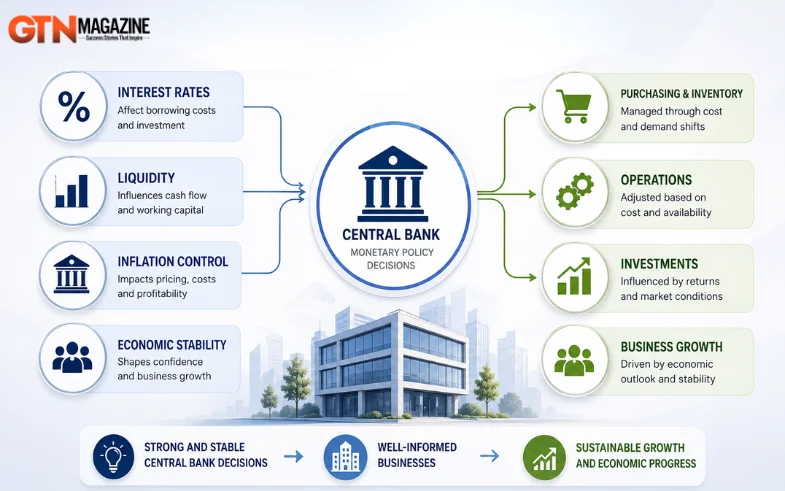
From borrowing costs and consumer spending to investment activity and international trade, central bank policies influence the financial conditions that determine how businesses grow, compete, and plan for the future. A change in interest rates, for example, can affect the cost of financing expansion projects. Inflation-control measures can influence pricing strategies, while monetary policy decisions can shape customer demand, hiring plans, and investor confidence.
In today's interconnected global economy, business leaders can no longer afford to view economic policy as a topic reserved for economists and financial institutions. Understanding how central bank decisions affect business operations has become an essential part of strategic planning. Organizations that closely monitor monetary policy trends are often better positioned to manage uncertainty, control costs, and identify growth opportunities before their competitors.
As economic conditions continue to evolve, the relationship between central bank actions and business performance becomes increasingly important. The ability to anticipate and respond to policy changes can provide organizations with a significant competitive advantage in both stable and challenging economic environments.
The Role of Central Banks in the Economy
Central banks serve as the primary monetary authorities within their respective countries or economic regions. Their primary responsibility is to maintain economic stability while supporting sustainable growth. Unlike commercial banks that provide loans and financial services directly to consumers and businesses, central banks oversee the broader financial system and implement policies designed to influence economic activity.
One of the main objectives of a central bank is maintaining price stability. Excessive inflation can reduce purchasing power and create uncertainty, while extremely low inflation or deflation can slow economic growth. To maintain balance, central banks continuously monitor economic indicators such as employment levels, consumer spending, production activity, and market conditions.
Their decisions influence the availability and cost of money throughout the economy. When central banks adjust monetary policy, the effects extend far beyond financial markets and ultimately influence how businesses operate, invest, hire employees, and serve customers.
Key Responsibilities of Central Banks
-
Managing inflation and price stability
-
Setting benchmark interest rates
-
Regulating money supply
-
Supporting employment and economic growth
-
Maintaining financial system stability
-
Managing currency reserves
-
Monitoring financial institutions and markets
Although these responsibilities may appear distant from everyday business operations, they create the economic conditions that shape corporate decision-making across virtually every industry.
Interest Rates and Their Impact on Business Financing
Among all the tools available to central banks, interest rates have the most immediate and visible effect on business operations. Interest rates determine how expensive it is to borrow money and influence both business and consumer behavior throughout the economy.
When central banks increase interest rates, borrowing becomes more costly. Businesses that rely on loans to finance equipment purchases, facility expansions, technology investments, or operational expenses may face significantly higher financing costs. As a result, many organizations become more cautious about making large investments and may postpone growth initiatives until economic conditions improve.
For example, a manufacturing company planning to build a new production facility may reconsider its investment timeline if financing costs rise substantially. Similarly, a retail chain looking to expand into new markets may choose to delay opening additional locations until borrowing conditions become more favorable.
Conversely, when central banks reduce interest rates, businesses often gain access to cheaper capital. Lower financing costs encourage investment, expansion, innovation, and hiring. Companies are more willing to pursue growth opportunities when borrowing becomes affordable and future returns appear more attractive.
The impact of interest rates is particularly significant because it affects not only large corporations but also small and medium-sized enterprises that depend on access to credit for daily operations and long-term development.
Areas Most Affected by Interest Rate Changes
-
Business loans and credit facilities
-
Equipment financing
-
Commercial real estate investments
-
Corporate expansion projects
-
Startup funding and venture capital activity
-
Mergers and acquisitions
-
Research and development investments
Organizations that closely monitor interest rate trends can make more informed financial decisions and better position themselves for changing economic conditions.
Inflation and Rising Operational Costs
Inflation is one of the most important economic factors influencing business performance. It refers to the general increase in prices across an economy over time and affects virtually every aspect of business operations.
When inflation rises, organizations often experience higher costs for raw materials, transportation, utilities, technology services, and labor. These rising expenses can place significant pressure on profit margins, particularly for businesses operating in competitive industries where raising prices may be difficult.
Manufacturers may face higher production costs as the prices of materials increase. Service providers may experience rising wage demands as employees seek compensation adjustments to offset higher living expenses. Retailers may encounter increased logistics and inventory costs, making it more challenging to maintain profitability.
The challenge for business leaders lies in balancing operational costs with customer expectations. While increasing prices may help offset inflationary pressures, excessive price adjustments can reduce demand and weaken customer loyalty.
Central banks often respond to inflation by tightening monetary policy, usually through interest rate increases. Although these measures are designed to stabilize prices, they can also slow economic activity in the short term. Businesses must therefore remain flexible and adapt their strategies to changing economic conditions.
Consumer Spending and Business Revenue
Consumer spending represents a major driver of economic growth and business revenue. Central bank decisions significantly influence consumer behavior by affecting borrowing costs, savings rates, and overall confidence in the economy.
When interest rates are low, consumers often feel more comfortable spending money. Mortgage payments become more affordable, financing costs decrease, and access to credit improves. This typically results in stronger demand for products and services across multiple industries.
Retail businesses, hospitality companies, automotive manufacturers, travel operators, and entertainment providers often benefit from increased consumer spending during periods of accommodative monetary policy.
However, when central banks raise interest rates to combat inflation, consumer behavior often changes. Higher borrowing costs can encourage households to reduce discretionary spending and prioritize saving. As a result, businesses may experience slower sales growth, reduced customer demand, and increased competition.
Understanding how monetary policy influences consumer confidence is essential for effective business planning. Organizations that anticipate shifts in customer behavior can adjust inventory levels, marketing strategies, and sales forecasts more effectively.
The Influence on Business Investment and Expansion
Long-term business growth depends heavily on investment. Whether an organization is considering opening new facilities, entering international markets, upgrading technology systems, or launching innovative products, investment decisions are influenced by economic conditions.
Central bank policies play a crucial role in determining whether businesses feel confident enough to pursue expansion opportunities. Low-interest-rate environments often encourage investment because financing costs remain manageable and economic growth prospects appear favorable.
Businesses are generally more willing to commit resources to future projects when capital is accessible and economic conditions support growth. This can lead to increased productivity, innovation, job creation, and market expansion.
In contrast, periods of higher interest rates often encourage caution. Organizations may focus on maintaining operational efficiency and preserving cash flow rather than pursuing aggressive growth strategies. Large-scale projects may be delayed until borrowing costs decline or economic uncertainty decreases.
The connection between monetary policy and business investment highlights why central bank announcements receive close attention from executives, investors, and financial analysts worldwide.
Currency Fluctuations and International Business Operations
For companies involved in international trade, central bank decisions can influence exchange rates and global competitiveness. Changes in interest rates often affect currency values because they influence investor behavior and capital flows between countries.
When a country's interest rates increase, its currency may strengthen as investors seek higher returns. While a stronger currency can reduce the cost of imported goods and materials, it can also make exports more expensive for international buyers.
On the other hand, lower interest rates may weaken a currency, making exports more competitive but increasing the cost of imported products and resources.
Businesses operating internationally must carefully manage these fluctuations because exchange rate movements can significantly affect profitability, pricing strategies, and supply chain costs.
Businesses Most Sensitive to Currency Movements
-
Export-oriented manufacturers
-
Import-dependent retailers
-
International technology firms
-
Global logistics providers
-
Multinational corporations
-
Tourism and hospitality businesses
Organizations that develop effective currency risk management strategies are often better equipped to maintain stability during periods of exchange-rate volatility.
Hiring Decisions and Workforce Planning
Central bank policies also influence labor markets and workforce planning. During periods of economic growth supported by favorable monetary conditions, businesses often expand their workforce to meet increasing demand.
Low borrowing costs and strong consumer spending can encourage organizations to invest in talent acquisition, employee development, and workforce expansion. Companies may feel more confident creating new positions and increasing compensation packages when business prospects appear positive.
However, when economic conditions become more restrictive, businesses often adopt a more cautious approach. Hiring plans may be delayed, recruitment budgets reduced, and workforce growth initiatives reassessed.
Because labor costs represent one of the largest expenses for many organizations, workforce planning remains closely linked to broader economic conditions shaped by central bank decisions.
Strategies Businesses Can Use to Navigate Central Bank Policy Changes
While businesses cannot control monetary policy decisions, they can take proactive steps to reduce risk and improve resilience during periods of economic uncertainty.
Successful organizations often focus on maintaining financial flexibility and preparing for multiple economic scenarios. Rather than reacting after policy changes occur, they build strategies that allow them to adapt quickly as conditions evolve.
Practical Strategies for Business Leaders
-
Maintain healthy cash reserves
-
Manage debt levels responsibly
-
Monitor economic indicators regularly
-
Diversify revenue streams
-
Improve operational efficiency
-
Strengthen financial forecasting processes
-
Build flexible business models
-
Evaluate financing options proactively
Businesses that prioritize adaptability are often better positioned to navigate changing economic environments while continuing to pursue long-term growth objectives.
Conclusion
Central bank decisions influence far more than financial markets. They shape the economic foundation upon which businesses operate, affecting borrowing costs, inflation levels, consumer demand, investment activity, workforce planning, and international trade.
While monetary policy may seem removed from daily business operations, its effects are felt across every stage of organizational decision-making. A shift in interest rates can influence expansion plans, inflation can reshape pricing strategies, and changes in consumer confidence can affect revenue growth.
For modern business leaders, understanding the relationship between central bank policy and business performance is no longer optional. It is a critical component of strategic planning and risk management. Organizations that monitor economic developments, anticipate policy changes, and adapt proactively are often better equipped to manage uncertainty and capitalize on emerging opportunities.
As global economies continue to evolve, businesses that combine strong operational leadership with a deep understanding of economic forces will be best positioned to achieve sustainable growth, financial resilience, and long-term success.
You may also like:-