


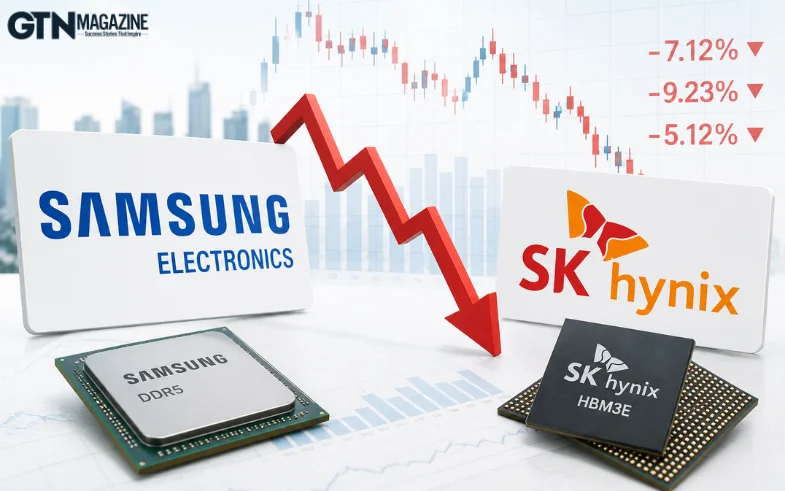
South Korean technology stocks came under heavy selling pressure on Thursday as a broad semiconductor selloff on Wall Street spilled into Asian markets, sending shares of Samsung Electronics and SK Hynix sharply lower.
Samsung Electronics dropped more than 7% in early trading, while memory chip maker SK Hynix fell over 9%, erasing billions of dollars in market value. The decline also dragged South Korea's benchmark Kospi index lower as investors moved away from technology stocks.
The selloff followed a weak trading session in the United States, where semiconductor companies led losses on the Nasdaq. Investors booked profits after a strong rally in AI-related stocks earlier this year, weighing heavily on global chipmakers.
Among the biggest losers on Wall Street, Micron Technology declined by more than 10%, while storage company SanDisk also posted double-digit losses. AI chip leader Nvidia and networking giant Broadcom ended the session lower, adding to negative sentiment across the sector.
Despite the market downturn, SK Hynix announced an ambitious long-term investment plan aimed at strengthening its semiconductor manufacturing capacity.
The company said it will invest 100 trillion won (approximately $64 billion) in South Korea to expand production facilities and support growing demand for artificial intelligence memory chips. The investment includes construction of the M17 fabrication plant, which is expected to begin next year, with commercial operations scheduled for the first half of 2029.
Around 80 trillion won will be allocated to the new NAND flash memory facility, while the remaining 20 trillion won will be invested in advanced chip packaging and assembly technologies.
Speaking during a public briefing in Asan, SK Hynix Chief Executive Kwak Noh-jung said the expansion is designed to meet rising global demand for high-bandwidth memory (HBM), DRAM, enterprise solid-state drives, and other AI-related semiconductor products.
The company also revealed plans to expand artificial intelligence data center infrastructure across South Korea. Initial capacity is expected to reach 5 gigawatts, with a long-term goal of increasing that figure to 15 gigawatts.
The announcement follows the South Korean government's recent commitment to strengthen the country's semiconductor industry through large-scale investment initiatives. Earlier this week, officials unveiled plans supporting a national semiconductor ecosystem, with Samsung Electronics and SK Hynix expected to invest a combined 800 trillion won over the coming years.
Although the latest investment plans underscore confidence in long-term demand driven by artificial intelligence, Thursday's market reaction reflected growing caution among investors as global technology stocks undergo a broad correction following months of strong gains.
Market participants will now be watching upcoming earnings reports, AI demand trends and broader global economic conditions to determine whether the recent weakness in semiconductor stocks proves temporary or signals a deeper pullback.